The Bloomfield Track runs from Cape Tribulation to the The Bloomfield River for 32 kms and is a true 4WD Track as there is very little gravel on parts of the surface, unimproved creek crossings, steep climbs and plenty of opportunity to get stuck if it is wet. The actual condition of the road varies enormously, and it can be anything from an easy drive, to almost or completely impassable.
Rykers Bridge
It was fun bouncing up and down and listening to the "squish" of tyres as they went through the water on the roads. There are two steep climbs and descents on the track — Donovan's Range is 20% (1:5), and Cowie Range is up to 33% (1:3).
Bloomfield Road Sign
Normally the creeks are alright, but in wet weather there can be at least 4 challenging crossings. Most 4WD vehicles can only cross about 0.6m depth of water before the risk of damage, and even if the vehicle is capable of a deeper crossing, the strong current can easily wash 4WDs away!
Bloomfield Track
There was a fair amount of water on the track and along the side. Sometimes the road sort of breaks up and you gets lots of mud. The road surface can be loose and slippery even when dry. At times I thought we weren't going to make it, but Allan, our driver knew the ropes having done this many times before. It wasn't till we arrived in Cooktown, that I realised Allan was not only our driver, but also the owner of the company.
Bloomfield Track
You can get lots of dust which blows up around.
Track History
The Bloomfield Track was pushed through from Cape Tribulation to Bloomfield in 1983. It was constructed amidst vehement protests from within the environment movement resulting in pitched battles at the site of construction between protesters and the police. Eventually the track was completed providing a 4wd thoroughfare from Cape Tribulation to just south of the Bloomfield River where it connected with an existing road which carried on through Ayton to connect with the Cape York Peninsula Developmental Road leading to Cooktown.
Tropical Far North Queensland
This is about my holiday from Cairns to
Laura, on the lower Cape York Peninsula from
September 2008 to October 2008. Going from Melbourne to Cairns to Port Douglas, to Cooktown and Laura, Cape Tribulation and all the bits in between, and finally back to Cairns for my flight home.
Cheers.
Laura, on the lower Cape York Peninsula from
September 2008 to October 2008. Going from Melbourne to Cairns to Port Douglas, to Cooktown and Laura, Cape Tribulation and all the bits in between, and finally back to Cairns for my flight home.
Cheers.
Drive The Daintree
Showing posts with label zTrees and Flowers. Show all posts
36. Low Isles - Island Walk
Sunday 28 September
The Low Isles are a Marine National Park Zone. Day visitors can come to the island via a number of commercial operators. There is a lagoon where private vessels can moor or anchor overnight, but there is no overnight accommodation on the island. There is a weather station, a lighthouse and the University of Queensland's research station.
There are two islands - Woody Island and Low Island, but it is to Low Island that the visitors come. Low Island is a "typical" tropical island - just like you see on the movies. It is a smaller vegetated, sandy, coral cay surrounded by 55 acres of reef.
Low Isles Map
No fishing is allowed in the lagoon or within a buffer zone around the islands.
Personal Palms
There are several shady palms - you get your own personal palm. One had two maroon chairs which are "reserved" the the crew - the Skipper and the First Mate!
Around The Island
I did a nature walk around the island. Low Isles are low, wooded islands, an island type unique to the GBR. The story begins around 7,000 years ago.....
As rising sea slowly covered the top of an ancient reef, dead corals were swept onto the reef flat. Heavy fragments settled on the windward side, building up a barrier. Mangrove seeds established in behind the barrier and Woody Island was formed.
Finer coral fragments were blown onto the sheltered corner of the reef flat. A low sandy cay emerged - Low Island.
Shady Trees
With their heavy cloak of vegetation, the islands are home to many birds - Osprey, Varied Honeyeater, Pied Imperial Pigeon, Sooty Oyster, White-Breasted Woodswallow, Mangrove Kingfisher.
Palms
In 1992 local people mindful of their neighbourly responsibilities, formed the Low Isles Preservation Society to protect Low Isles and promote reef research and education.
Many years of habitation has left its mark on Low Island - coconuts are more plentiful than on a "pristine" cay and exotic plants bear witness to diligent gardening by previous residents. Some exotic plants brought to the island include Singapore Daisy, Frangipani and Hibiscus. Today, Low Island is managed to prevent further imapacts, especially from visitors to this special place.
Low Isles Lighthouse
The Low Isles tower (1878) was constructed on a timber frame with a galvanised sheath in the typical Queensland fashion, and it was the first to have porthole windows. . Attached to the top was a 1.5m diameter lantern manufactured by Chance Bros of Birmingham, England.
A timber staircase gives access to the lantern room. The tower was painted white with a red dome. All the buildings were prefabricated elsewhere and transported and assembled on site.
The final cost of the lightstation was: capital cost of buildings - £4,090, cost of optical apparatus- £1,389. The island the tower is now controlled
by Queensland Parks and Wildlife.
Lighthouse
The Low Isles Lighthouse is on a low flat coral cay surrounded by thick vegetation. You can read further information and history here.
Research Station
The University of Queensland's Low Isles Research Station was previously the assistant lighthouse keeper's house. The research station consists of one house only, with good laboratory facilities located below, and can accommodate a maximum of 6 scientists.
Low Isles Research Station works closely with the ecotourism vessel Undersea Explorer, supporting quality research projects, promoting field work opportunities for University students and providing an exciting and stimulating reef adventure for scientists and students.
Shed
The shed is part of the research station.
Island View
Back to where I started. It was lovely strolling around the island - no noise save for the sound of birds and the leaves rustling in the gentle breeze. No smelly polutants, just clean, fresh air with the sun on your face and a feeling of timelessness.
The Low Isles are a Marine National Park Zone. Day visitors can come to the island via a number of commercial operators. There is a lagoon where private vessels can moor or anchor overnight, but there is no overnight accommodation on the island. There is a weather station, a lighthouse and the University of Queensland's research station.
There are two islands - Woody Island and Low Island, but it is to Low Island that the visitors come. Low Island is a "typical" tropical island - just like you see on the movies. It is a smaller vegetated, sandy, coral cay surrounded by 55 acres of reef.
Low Isles Map
No fishing is allowed in the lagoon or within a buffer zone around the islands.
Personal Palms
There are several shady palms - you get your own personal palm. One had two maroon chairs which are "reserved" the the crew - the Skipper and the First Mate!
Around The Island
I did a nature walk around the island. Low Isles are low, wooded islands, an island type unique to the GBR. The story begins around 7,000 years ago.....
As rising sea slowly covered the top of an ancient reef, dead corals were swept onto the reef flat. Heavy fragments settled on the windward side, building up a barrier. Mangrove seeds established in behind the barrier and Woody Island was formed.
Finer coral fragments were blown onto the sheltered corner of the reef flat. A low sandy cay emerged - Low Island.
Shady Trees
With their heavy cloak of vegetation, the islands are home to many birds - Osprey, Varied Honeyeater, Pied Imperial Pigeon, Sooty Oyster, White-Breasted Woodswallow, Mangrove Kingfisher.
Palms
In 1992 local people mindful of their neighbourly responsibilities, formed the Low Isles Preservation Society to protect Low Isles and promote reef research and education.
Many years of habitation has left its mark on Low Island - coconuts are more plentiful than on a "pristine" cay and exotic plants bear witness to diligent gardening by previous residents. Some exotic plants brought to the island include Singapore Daisy, Frangipani and Hibiscus. Today, Low Island is managed to prevent further imapacts, especially from visitors to this special place.
Low Isles Lighthouse
The Low Isles tower (1878) was constructed on a timber frame with a galvanised sheath in the typical Queensland fashion, and it was the first to have porthole windows. . Attached to the top was a 1.5m diameter lantern manufactured by Chance Bros of Birmingham, England.
A timber staircase gives access to the lantern room. The tower was painted white with a red dome. All the buildings were prefabricated elsewhere and transported and assembled on site.
The final cost of the lightstation was: capital cost of buildings - £4,090, cost of optical apparatus- £1,389. The island the tower is now controlled
by Queensland Parks and Wildlife.
Lighthouse
The Low Isles Lighthouse is on a low flat coral cay surrounded by thick vegetation. You can read further information and history here.
Research Station
The University of Queensland's Low Isles Research Station was previously the assistant lighthouse keeper's house. The research station consists of one house only, with good laboratory facilities located below, and can accommodate a maximum of 6 scientists.
Low Isles Research Station works closely with the ecotourism vessel Undersea Explorer, supporting quality research projects, promoting field work opportunities for University students and providing an exciting and stimulating reef adventure for scientists and students.
Shed
The shed is part of the research station.
Island View
Back to where I started. It was lovely strolling around the island - no noise save for the sound of birds and the leaves rustling in the gentle breeze. No smelly polutants, just clean, fresh air with the sun on your face and a feeling of timelessness.
33. Port Douglas - Rainforest Habitat 3
Saturday 27 September
The Rainforest
Representing the Wet Tropics rainforest environments where native species such as the Southern Cassowary, Boyd’s Forest Dragon and colourful Eclectus parrots can be viewed in a natural setting. Boardwalks meander along the forest floor to the rainforest canopy.
Southern Cassowary
Despite being a bird, the Cassowary is Australia’s largest land animal. Reaching 200 cm and weighing up to 83 kg it's so big it's unable to fly. It has glossy black plumage, two dangling red wattles and a big bony lump on its head called a casque, and live in tropical rainforest and feed mostly on fallen fruit.
The Cassowary is an endangered species, with estimates of only 1500 remaining - its extinction could affect rainforest plant diversity as it helps spread the seeds of up to 100 tree and shrub species. Its relatives such as the Elephant Bird of Madagascar and the Moas of New Zealand became extinct after contact with humans.
Eastern Water Dragon
Eastern Water Dragon (Physignathus lesuerii) Australian water dragons have long powerful limbs & claws for swimming & climbing & have a prominent nuchal & vertebral crest.
Including their tails which comprise about two-thirds of their total length adult females grow to about 60 cm long, & adult males up to 1mt & show bolder coloration, with red chests and larger heads than females.
Water dragons eat a wide variety of insects, molluscs, small fish & native fruit & scavenge around picnic areas & urban park.
Eclectus Parrot - male
The male Eclectus Parrot is bright green except for red under the wings and a bright orange beak and a black tail.
Eclectus Parrot - female
The female Eclectus Parrot is so different it was once thought to be a different species. It is bright scarlet except for a dark blue belly and back and a black beak. Even tiny Eclectus Parrots look different. Male chicks are a grey ball of fluff, female chicks are a black ball of fluff.
They grow up in a hollow high in a rainforest tree where the female lays two eggs. And she almost never leaves them in case another female takes her nest hole. She does not starve because lots of different males come to feed her rainforest seeds and fruits at her nest.
The diet of the eclectus in the wild consists of mainly fruits, unripe nuts, flower and leaf buds, and some seeds In captivity, they will eat most fruits including mangos, figs, guavas, bananas, any melons, stone fruits (peaches etc), grapes, citrus fruits, pears and apples.
Plantlife
Some of the many plants at the Habitat.
The souvenir shop has a good range of items and I bought a Kingfisher ($8.95) for a friend. One of the (toy) parrots said 'hello'. Caught the bus at 11.30, and promptly fell asleep as soon as I reached the hostel. Watched the Grand Final in the Bar. The Hawks defeated the Cats by 26 points - 109 to 83. Yay! Although I follow the Bombers, Grandad followed Hawthorn and I was barracking for them.
The Rainforest
Representing the Wet Tropics rainforest environments where native species such as the Southern Cassowary, Boyd’s Forest Dragon and colourful Eclectus parrots can be viewed in a natural setting. Boardwalks meander along the forest floor to the rainforest canopy.
Southern Cassowary
Despite being a bird, the Cassowary is Australia’s largest land animal. Reaching 200 cm and weighing up to 83 kg it's so big it's unable to fly. It has glossy black plumage, two dangling red wattles and a big bony lump on its head called a casque, and live in tropical rainforest and feed mostly on fallen fruit.
The Cassowary is an endangered species, with estimates of only 1500 remaining - its extinction could affect rainforest plant diversity as it helps spread the seeds of up to 100 tree and shrub species. Its relatives such as the Elephant Bird of Madagascar and the Moas of New Zealand became extinct after contact with humans.
Eastern Water Dragon
Eastern Water Dragon (Physignathus lesuerii) Australian water dragons have long powerful limbs & claws for swimming & climbing & have a prominent nuchal & vertebral crest.
Including their tails which comprise about two-thirds of their total length adult females grow to about 60 cm long, & adult males up to 1mt & show bolder coloration, with red chests and larger heads than females.
Water dragons eat a wide variety of insects, molluscs, small fish & native fruit & scavenge around picnic areas & urban park.
Eclectus Parrot - male
The male Eclectus Parrot is bright green except for red under the wings and a bright orange beak and a black tail.
Eclectus Parrot - female
The female Eclectus Parrot is so different it was once thought to be a different species. It is bright scarlet except for a dark blue belly and back and a black beak. Even tiny Eclectus Parrots look different. Male chicks are a grey ball of fluff, female chicks are a black ball of fluff.
They grow up in a hollow high in a rainforest tree where the female lays two eggs. And she almost never leaves them in case another female takes her nest hole. She does not starve because lots of different males come to feed her rainforest seeds and fruits at her nest.
The diet of the eclectus in the wild consists of mainly fruits, unripe nuts, flower and leaf buds, and some seeds In captivity, they will eat most fruits including mangos, figs, guavas, bananas, any melons, stone fruits (peaches etc), grapes, citrus fruits, pears and apples.
Plantlife
Some of the many plants at the Habitat.
The souvenir shop has a good range of items and I bought a Kingfisher ($8.95) for a friend. One of the (toy) parrots said 'hello'. Caught the bus at 11.30, and promptly fell asleep as soon as I reached the hostel. Watched the Grand Final in the Bar. The Hawks defeated the Cats by 26 points - 109 to 83. Yay! Although I follow the Bombers, Grandad followed Hawthorn and I was barracking for them.
22. Atherton Tablelands - Yungaburra
Tuesday 23 September
Nestled in the Atherton Tablelands is the village of Yungaburra and on the advice of a friend, I had lunch at the Yungaburra Pub (Lake Eacham Hotel. They were the best lamb chops I'd had in a long time - three chops, mashed potato, pumpkin, carrot, broccoli, zucchini, gravy and mint sauce, and all for $17! Add a glass of wine ($4) and you have the makings of a delicious meal.
The Yungaburra Pub
This grand old lady is a wonderful showpiece of Federation architecture and is still in amazingly original condition both inside and out. With all the style of a bygone eras it has seen since it was first built in 1910, the time of the timber getters is reflected in cedar and silky oak - visiting dignitaries to the enormous ballroom are preserved forever in photo frames and there is an excellent collection of general memorabilia on show.
The Verandah
A lovely spot to enjoy a quiet drink and a smoke with a refreshing breeze.
The Sign
I was amused by the "Toilet Ethics" sign - I wonder how many people adhere to this?
Whistle Stop Cafe
On the corner opposite the pub is this lovely little "cottage" with all sorts of delicious cakes plus an assortment of "cottagey" type crafts.
Another Sign
I thought this sign was so quaint, I just had to take a photo of it for posterity!
Curtain Strangler Fig
This is the tree that all the tour companies go to.
A short drive (about 1 km) from Yungaburra is this magnificant Strangler Fig - directions to this fantastic tree are well sign-posted and it is well worth it. There are interpretative signs which describe how the Curtain Fig Tree grew and some additional interesting information.
A closer look
There is a continuous board walk around the tree and a section which creates good perspective for photo opportunities. Lumholtz Tree Kangaroos & Green Possums can sometimes be seen asleep in this area during daylight. After dark you can spotlight for Tree Kangaroos, Green Possums, Herbert River Possums and Coppery Brushtail Possums.
Did you know that to count the tangled roots of the Curtain Fig would take a week?
The Top
It is one of the largest trees in north Queensland, and one of the best known attractions on the Tablelands, and its curtain of aerial roots drop 15 metres (49 feet) to the ground. Large basalt boulders cover the forest floor, which is probably why the forest here wasn't cleared for farming - and why the curtain fig tree remains standing.
The Curtain Fig Cycle
1. A seed is deposited in the host tree's crown in bird, possum, tree kangaroo or rat droppings.
The seed germinates and its first root begins to descend to the soil.
2. Enriched by the soil, the fig develops aerial roots which encircle
and eventually strangles the host tree.
3. This stage is unique in the development of the Curtain Fig Tree.
The host tree falls into a neighbouring tree and vertical fig roots descend
from its leaning trunk to form the curtain like appearance.
4. Eventually the host tree rots away leaving the free standing Fig Tree.
Nestled in the Atherton Tablelands is the village of Yungaburra and on the advice of a friend, I had lunch at the Yungaburra Pub (Lake Eacham Hotel. They were the best lamb chops I'd had in a long time - three chops, mashed potato, pumpkin, carrot, broccoli, zucchini, gravy and mint sauce, and all for $17! Add a glass of wine ($4) and you have the makings of a delicious meal.
The Yungaburra Pub
This grand old lady is a wonderful showpiece of Federation architecture and is still in amazingly original condition both inside and out. With all the style of a bygone eras it has seen since it was first built in 1910, the time of the timber getters is reflected in cedar and silky oak - visiting dignitaries to the enormous ballroom are preserved forever in photo frames and there is an excellent collection of general memorabilia on show.
The Verandah
A lovely spot to enjoy a quiet drink and a smoke with a refreshing breeze.
The Sign
I was amused by the "Toilet Ethics" sign - I wonder how many people adhere to this?
Whistle Stop Cafe
On the corner opposite the pub is this lovely little "cottage" with all sorts of delicious cakes plus an assortment of "cottagey" type crafts.
Another Sign
I thought this sign was so quaint, I just had to take a photo of it for posterity!
Curtain Strangler Fig
This is the tree that all the tour companies go to.
A short drive (about 1 km) from Yungaburra is this magnificant Strangler Fig - directions to this fantastic tree are well sign-posted and it is well worth it. There are interpretative signs which describe how the Curtain Fig Tree grew and some additional interesting information.
A closer look
There is a continuous board walk around the tree and a section which creates good perspective for photo opportunities. Lumholtz Tree Kangaroos & Green Possums can sometimes be seen asleep in this area during daylight. After dark you can spotlight for Tree Kangaroos, Green Possums, Herbert River Possums and Coppery Brushtail Possums.
Did you know that to count the tangled roots of the Curtain Fig would take a week?
The Top
It is one of the largest trees in north Queensland, and one of the best known attractions on the Tablelands, and its curtain of aerial roots drop 15 metres (49 feet) to the ground. Large basalt boulders cover the forest floor, which is probably why the forest here wasn't cleared for farming - and why the curtain fig tree remains standing.
The Curtain Fig Cycle
1. A seed is deposited in the host tree's crown in bird, possum, tree kangaroo or rat droppings.
The seed germinates and its first root begins to descend to the soil.
2. Enriched by the soil, the fig develops aerial roots which encircle
and eventually strangles the host tree.
3. This stage is unique in the development of the Curtain Fig Tree.
The host tree falls into a neighbouring tree and vertical fig roots descend
from its leaning trunk to form the curtain like appearance.
21. Atherton Tablelands - Giants and Waterfalls
Tuesday 23 September
More in the Tea House gardens.
Waterfall
In a quiet shady spot amid luscious ferns and towering trees is this waterfall.
Twin Kauri
These towering bull kauris (Agathis microstachya), are over 45 meteres tall and 6 metres in girth, and are the largest of Australia's 38 conifer (pine) species.
Easily the best known botanical feature of Lake Barrine, these twin Rough Barked Kauri Pine are estimated to be about 1,000 years old and are considered one of the earliest known species of rainforest tree.
The Bull Kauri species is the largest of all the Kauri’s on record and it is a pine even though it does not have a needle leaf. ‘Kauri Pine’ is the common name derived from the Maori name of the related New Zealand Kauri species (Agathis Australis).
More in the Tea House gardens.
Waterfall
In a quiet shady spot amid luscious ferns and towering trees is this waterfall.
Twin Kauri
These towering bull kauris (Agathis microstachya), are over 45 meteres tall and 6 metres in girth, and are the largest of Australia's 38 conifer (pine) species.
Easily the best known botanical feature of Lake Barrine, these twin Rough Barked Kauri Pine are estimated to be about 1,000 years old and are considered one of the earliest known species of rainforest tree.
The Bull Kauri species is the largest of all the Kauri’s on record and it is a pine even though it does not have a needle leaf. ‘Kauri Pine’ is the common name derived from the Maori name of the related New Zealand Kauri species (Agathis Australis).
20. Atherton Tablelands - Tea House Gardens
Tuesday 23 September
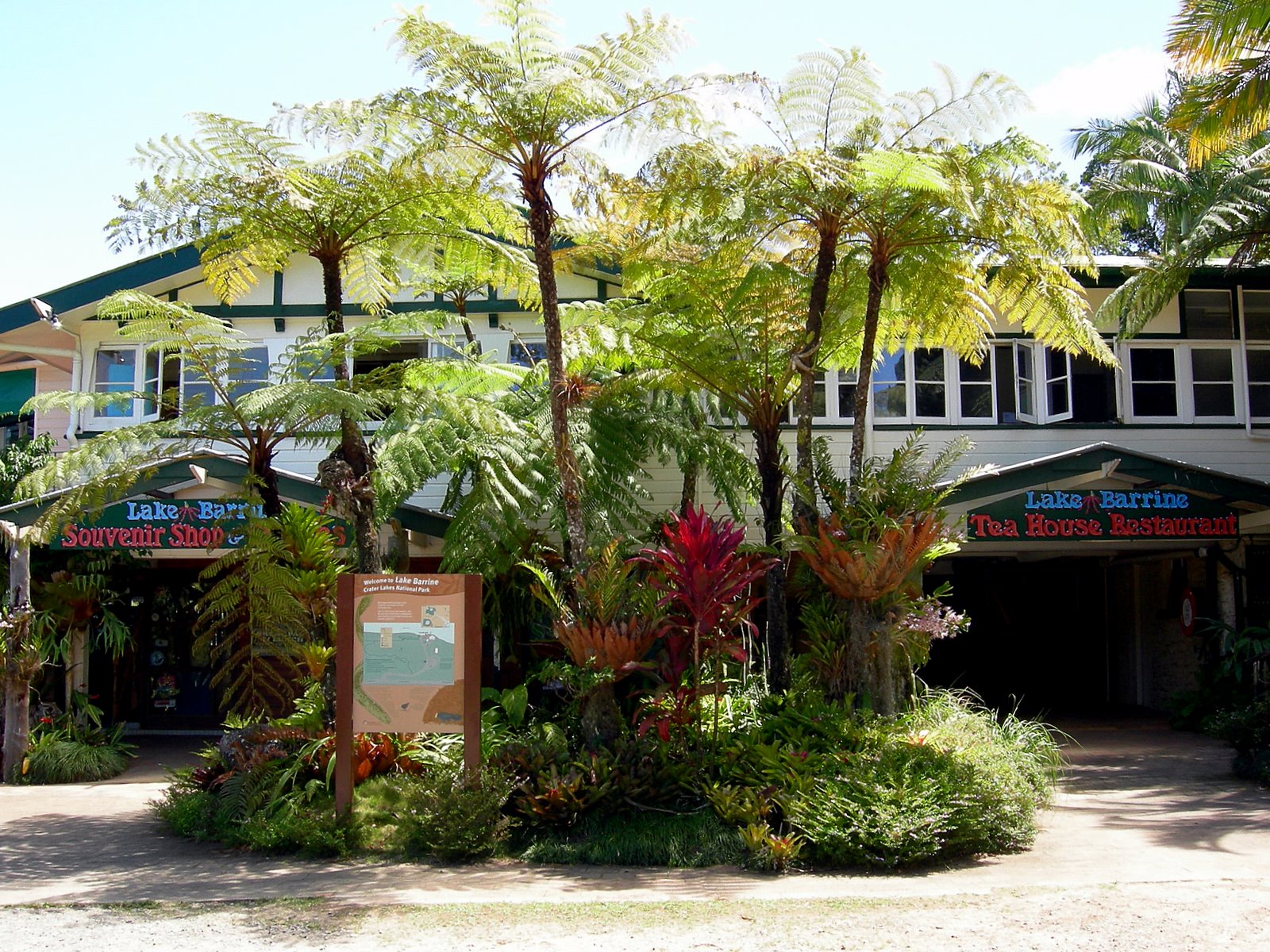
The gardens surrounding the Lake Barrine Tea House are magnificant, with ferns, kauri, and brightly coloured tropical plants.
Tea House Ferns
A Shady Spot
Elkhorn
The Elkhorn fern is an epiphyte, growing on the trunks and branches of trees. Each plant is composed of a mass of plantlets. A plantlet consists of a nest leaf 12-30 cm wide, lying against the bark of the host tree. The nest leaves of neighbouring plantlets overlap one another.
Cordyline Rubra
I saw many of these bright red leafed plants in Queensland - they are hardy and drought restistant and can grow in either full sun or part shade.
Collage
This is a collage of some of the flowers in the garden.
The gardens surrounding the Lake Barrine Tea House are magnificant, with ferns, kauri, and brightly coloured tropical plants.
Tea House Ferns
A Shady Spot
Elkhorn
The Elkhorn fern is an epiphyte, growing on the trunks and branches of trees. Each plant is composed of a mass of plantlets. A plantlet consists of a nest leaf 12-30 cm wide, lying against the bark of the host tree. The nest leaves of neighbouring plantlets overlap one another.
Cordyline Rubra
I saw many of these bright red leafed plants in Queensland - they are hardy and drought restistant and can grow in either full sun or part shade.
Collage
This is a collage of some of the flowers in the garden.
19. Atherton Tablelands - Lake Barrine
Tuesday 23 September
After seeing the Cathedral Strangler Fig, I made my way to the Lake Barrine Tea House for my (second) morning tea stop. Their Devonshire teas are legendary and the view from the outdoor balcony was magnificent.
Lake Barrine Tea House
Devonshire Tea
The scones were freshly baked - still warm - and you get a proper pot of tea.
Views over Lake Barrine
The lake is a vivid deep blue and it was just perfect - heavenly!
The gardens were magnificent and I couldn't get over how wonderful and colourful it all was.
Twin Palms over the lake
Lake Barrine is on the eastern part of the Atherton Tablelands and is a volcanic maar surrounded by rainforest. The lake is in Crater Lakes National Park,
Lake Barrine
Lake cruises operate from the privately-owned Lake Barrine teahouse. The gentle boat trip gives a different perspective and more insights into the lake and its wildlife. The privately- owned teahouse offers meals with relaxed views over the water.
Looking South
Lake Barrine is actually the crater left by a volcanic eruption approximately 10,000 years ago.
There are three crater lakes in the Atherton Tablelands - Lake Barrine, Lake Eacham and Lake Euramoo. According to the Ngadjonji, when two men broke a taboo and angered the rainbow serpent, the earth roared like thunder and the winds blew like a cyclone. The ground began to move and crack and in the sky there appeared red clouds that had never before been see. The people were frightened and ran but were swallowed by a crack which opened in the earth.
After seeing the Cathedral Strangler Fig, I made my way to the Lake Barrine Tea House for my (second) morning tea stop. Their Devonshire teas are legendary and the view from the outdoor balcony was magnificent.
Lake Barrine Tea House
Devonshire Tea
The scones were freshly baked - still warm - and you get a proper pot of tea.
Views over Lake Barrine
The lake is a vivid deep blue and it was just perfect - heavenly!
The gardens were magnificent and I couldn't get over how wonderful and colourful it all was.
Twin Palms over the lake
Lake Barrine is on the eastern part of the Atherton Tablelands and is a volcanic maar surrounded by rainforest. The lake is in Crater Lakes National Park,
Lake Barrine
Lake cruises operate from the privately-owned Lake Barrine teahouse. The gentle boat trip gives a different perspective and more insights into the lake and its wildlife. The privately- owned teahouse offers meals with relaxed views over the water.
Looking South
Lake Barrine is actually the crater left by a volcanic eruption approximately 10,000 years ago.
There are three crater lakes in the Atherton Tablelands - Lake Barrine, Lake Eacham and Lake Euramoo. According to the Ngadjonji, when two men broke a taboo and angered the rainbow serpent, the earth roared like thunder and the winds blew like a cyclone. The ground began to move and crack and in the sky there appeared red clouds that had never before been see. The people were frightened and ran but were swallowed by a crack which opened in the earth.
18. Atherton Tablelands - Gillies Highway and Strangler Figs
Tuesday 23 September
Today I'm off to the Atherton Tablelands, and I'm going via the Gillies Highway. There are easier roads, but as soon as I heard of this twisting, winding road, I just knew I had to take it - I love winding roads. The Gillies HIghway is famous for its 200+ corners in 20 kms of road!
Below is a map showing the route I took.
Atherton Tablelands map
I drove down to Gordonvale then turned on to the Gillies Highway, from there I started the gradual climb through the luscious rainforest. The Gillies Highway ascends the mountain ranges starting at the small town of Gordonvale (30km south of Cairns). Over the next 30 kilometres you climb some 600-1000 metres to the Atherton Tablelands encountering spectacular lookouts along the way which enable you to take in the view of the valleys deep in the Great Dividing Range.
View from the Gillies Highway
The temperature drops and the air becomes fresher. This route offers spectracular views, especially from Heales Lookout.
Morning Tea Stop
This is one of the places I pulled over the side of the road where I had morning tea - I always bring along my Thermos flask.
Atherton Tablelands Hills
When you reach the top of the range, the rolling green hills of the Atherton Tablelands stretch out before you. After driving through Gadgarra, you take the right turn off through the Danbulla State Forest to get to the Cathedral Strangler Fig.
Cathedral Strangler Fig
The Cathedral Fig is a massive strangler fig tree - one of the most impressive sights in the rainforest along the Danbulla Forest Drive which runs around Lake Tinaroo, and is about 5 kms from the Gillies Highway. It is the same species of tree as the Curtain Fig Tree (Ficus virens), but through different growing pressure has evolved to display a different habit of the commonly called strangler fig.
Its massive system of buttress roots is surrounded by a boardwalk, and it is over 500 years old. It has the reputation of being the best place to hear an early morning bird 'singing' in the Atherton Tablelands.
Cathedral close-up
Many species of animal can be seen seeking shelter in and around the Cathedral Fig Tree including: Papuan Frog Mouth, Rose-crowned Fruit Dove, Emerald Fruit Dove, Pale-yellow and Grey-headed Robin, Orange-footed Scrubfowl, many species of reptile, Possums and Tree Kangaroo.
Click on the blue marker for a photo. You can also enlarge the map.
View Cathedral Strangler Fig in a larger map
Today I'm off to the Atherton Tablelands, and I'm going via the Gillies Highway. There are easier roads, but as soon as I heard of this twisting, winding road, I just knew I had to take it - I love winding roads. The Gillies HIghway is famous for its 200+ corners in 20 kms of road!
Below is a map showing the route I took.
Atherton Tablelands map
I drove down to Gordonvale then turned on to the Gillies Highway, from there I started the gradual climb through the luscious rainforest. The Gillies Highway ascends the mountain ranges starting at the small town of Gordonvale (30km south of Cairns). Over the next 30 kilometres you climb some 600-1000 metres to the Atherton Tablelands encountering spectacular lookouts along the way which enable you to take in the view of the valleys deep in the Great Dividing Range.
View from the Gillies Highway
The temperature drops and the air becomes fresher. This route offers spectracular views, especially from Heales Lookout.
Morning Tea Stop
This is one of the places I pulled over the side of the road where I had morning tea - I always bring along my Thermos flask.
Atherton Tablelands Hills
When you reach the top of the range, the rolling green hills of the Atherton Tablelands stretch out before you. After driving through Gadgarra, you take the right turn off through the Danbulla State Forest to get to the Cathedral Strangler Fig.
Cathedral Strangler Fig
The Cathedral Fig is a massive strangler fig tree - one of the most impressive sights in the rainforest along the Danbulla Forest Drive which runs around Lake Tinaroo, and is about 5 kms from the Gillies Highway. It is the same species of tree as the Curtain Fig Tree (Ficus virens), but through different growing pressure has evolved to display a different habit of the commonly called strangler fig.
Its massive system of buttress roots is surrounded by a boardwalk, and it is over 500 years old. It has the reputation of being the best place to hear an early morning bird 'singing' in the Atherton Tablelands.
Cathedral close-up
Many species of animal can be seen seeking shelter in and around the Cathedral Fig Tree including: Papuan Frog Mouth, Rose-crowned Fruit Dove, Emerald Fruit Dove, Pale-yellow and Grey-headed Robin, Orange-footed Scrubfowl, many species of reptile, Possums and Tree Kangaroo.
Click on the blue marker for a photo. You can also enlarge the map.
View Cathedral Strangler Fig in a larger map
4. Cairns - City In A Garden
Saturday 20 September
One thing that surprised me about Cairns was the tree lined streets woth vibrant foliage and providing shade and protection from the elements. Below are some photos of the ferns, trees and shrubs.
Opposite Cairns Plaza
There's seating provided by the brickwork which is comfortable and under some shade.
Shields Street and Lake Street
There's a lovely circular area here with paved bricks, seating and lots of trees and shrubs - car free of course.
Opposite the Global Palace
This is where the Cairns Transit Network is - the Lake Street Transit mall.
Some of the many flowers along the city streets.
These are abundant
Some of the trees and plants around Cairns
Box Fruit (Barringtonia asiatica), Cassowary Pine (Barringtonia calyptrata), Weeping Melaleuca (Melaleuca leucadendra), Yellow Peltophorum (Peltophorum pterocarpum), Silver Trumpet Tree (Tabebuia argentea), Brown Gardenia (Randia fitzalanii(, and Expo Golden Penda (Xanthostemon chrysanthus)
One thing that surprised me about Cairns was the tree lined streets woth vibrant foliage and providing shade and protection from the elements. Below are some photos of the ferns, trees and shrubs.
Opposite Cairns Plaza
There's seating provided by the brickwork which is comfortable and under some shade.
Shields Street and Lake Street
There's a lovely circular area here with paved bricks, seating and lots of trees and shrubs - car free of course.
Opposite the Global Palace
This is where the Cairns Transit Network is - the Lake Street Transit mall.
Some of the many flowers along the city streets.
These are abundant
Some of the trees and plants around Cairns
Box Fruit (Barringtonia asiatica), Cassowary Pine (Barringtonia calyptrata), Weeping Melaleuca (Melaleuca leucadendra), Yellow Peltophorum (Peltophorum pterocarpum), Silver Trumpet Tree (Tabebuia argentea), Brown Gardenia (Randia fitzalanii(, and Expo Golden Penda (Xanthostemon chrysanthus)
Subscribe to:
Posts (Atom)